Understanding EISA Registration Close Dates: Why Timing Matters in the Occupational Qualification Landscape
The shift to occupational qualifications has introduced new compliance structures, and with them, new risks if deadlines are missed. Among the most important are the EISA registration close dates, which directly influence learner completion turnaround times. For SDPs and employers, these timelines are more than administrative; they determine whether B-BBEE and Section 12H training benefits are realised or lost.

In the new occupational qualification landscape, timing is everything.
As South Africa fully transitions into the Occupational Qualification landscape, many Skills Development Providers (SDPs) and employers are beginning to experience the new realities of the External Integrated Summative Assessment (EISA) system.
While the change brings consistency and quality assurance, it also introduces a critical operational factor that is sometimes overlooked — EISA registration timelines.
Understanding these registration close dates is no longer just an administrative detail. It directly affects learner completion turnaround times, B-BBEE reporting, and the Section 12H tax allowances that employers depend on to recover training investments.
The new reality: Assessments are no longer flexible
Under the Quality Council for Trades and Occupations (QCTO) model, all learners completing an occupational qualification must undergo an External Integrated Summative Assessment (EISA) facilitated by a QCTO-accredited Assessment Centre.
Unlike traditional internal summative assessments, EISAs are centrally scheduled and externally managed, with specific dates scheduled for each occupational qualification along with strict registration deadlines for each EISA session.
Where SDPs were historically able to control learner exit dates and project completion timelines under the legacy qualification model, the introduction of the occupational qualification framework has changed this significantly. Under the new system, learner completion and certification are now directly tied to the External Integrated Summative Assessment (EISA) schedule. This means learners can only complete and exit an occupational qualification in alignment with the official EISA dates set for each qualification.
EISA registration close dates are typically three months prior the scheduled EISA date. No extensions or provisions are allowed in relation to missed EISA registrations by QCTO.
This means that:
If a SDP fails to register learners by the EISA registration cut-off, they cannot be assessed in that session.
The next available sitting could be several months later.
This directly delays learner completion, certification, and reporting

Why this matters for SDPs and employers
For SDPs, delayed assessment completions disrupt learner pipelines and contractual deliverables. For employers, the impact extends to financial and compliance consequences:
1. B-BBEE Skills Development Points
Delays in learner completions can mean that training spend and results are not recognised within the same financial year. This can reduce or even forfeit valuable B-BBEE Skills Development points, particularly for learnerships intended to close within a specific reporting cycle.
2. Section 12H Tax Allowances
Section 12H of the Income Tax Act allows employers to claim a tax deduction per learner registered on a learnership. However, final completion and certification are key evidence points required by SARS.
If learners are not assessed on time due to missed EISA registration windows, the employer may lose out on the completion allowance, significantly affecting ROI on training programmes.
Practical example of potential delays if missing an EISA registration date
SDP ABC have unemployed learners that have completed their occupational qualification on 15 November 2025. SDP ABC consults the QCTO EISA schedule and notes that the next EISA session for this occupational qualification will be in February 2026. SDP ABC feels comfortable that learners will only need to wait three months to complete their EISA. SDP ABC also arranges for learners to be paid their stipends (by the Lead Employer Company) during this period.
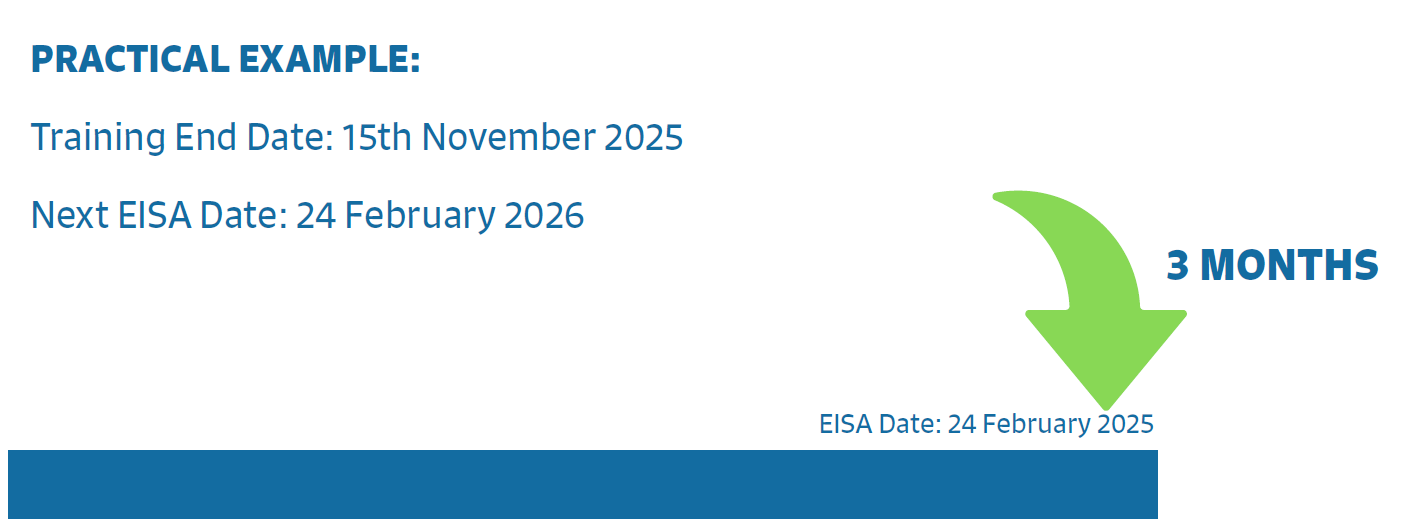
However, SDP ABC notes that the registration close date for this EISA session was 31 October 2025 and SDP ABC did not register learners by this registration close date as they had not yet completed their training components.
SDP ABC now registers learners for the next available EISA session which is in June 2026. The outcome of missing the EISA registration close date means that instead of SDP ABC’s learners waiting three months to complete their EISA they will now need to wait seven months. Their client, the Lead Employer, is also not pleased that they need to prospectively pay an additional four month’s stipends to these learners to ensure learner retention and completion.

The risk of this waiting period means that learners may forget their key learning outcomes or may forfeit the completion of their occupational qualification altogether. For the SDP’s client, the Lead Employer company, who invested in this training project, their claimable B-BBEE points in relation to their Skills Development Spend for the financial period may be impacted, and are unable to claim completion allowances in relation to the 12H Tax concessions. In addition, learners are disadvantaged due to the higher risk of failing their EISA due to the significant gap between their training and their exam.
The role of proactive EISA planning
To mitigate these risks, SDPs and employers must integrate EISA planning into their training calendars from the outset.
At EISA Hub, we advise our partners to:
Check EISA registration close dates as soon as training begins.
Align training completion schedules to coincide as closely as possible to registration close dates for the EISA session.
Allow enough time at the conclusion of training to conduct the requisite quality assurance and issue learners with their Statement of Results (SoR).
Prepare learners through mock EISAs and readiness resources to reduce the risk of deferrals or failures.
Partner with a reputable and experienced assessment at the onset of the training project to ensure that EISA planning is implemented within the key milestone dates.
Track completions to align certification with financial and B-BBEE reporting periods.
This proactive approach ensures learners are ready, assessments are completed on time, and compliance outcomes are fully achieved.

How EISA Hub supports SDPs
EISA Hub operates as a national QCTO-accredited Assessment Centre, offering over 60 occupational qualifications across multiple AQPs. Our streamlined model helps SDPs and employers manage EISAs efficiently through:
A centralised national booking system.
Clear session schedules and registration deadlines.
Regular reminders and updates on published EISA dates along with registration close dates.
Mock EISAs and learner readiness support via our digital platform.
Dedicated support for EISA registrations and implementation.
With one contact point, our clients can coordinate assessments across Gauteng, KwaZulu-Natal, and Western Cape ensuring national consistency and faster learner completions.
Final Thoughts
In the new occupational qualification landscape, timing is everything.
Understanding and aligning to EISA registration close dates is essential not just for compliance, but for maximising the financial and strategic benefits of skills development.
By planning ahead and partnering with an experienced national assessment centre like EISA Hub, SDPs and employers can ensure that learner completions are on schedule — and that every training investment translates into measurable results, from B-BBEE scorecards to Section 12H tax savings.
Make the Smart Choice with EISA Hub
Choosing EISA Hub means partnering with a reliable, non-competing assessment centre that understands the complexities of EISA delivery. With our national footprint, proven compliance record, and end-to-end support, we help SDPs streamline the process, protect their client relationships, and ensure their learners are set up for success. Trust EISA Hub to be your strategic partner in navigating the EISA journey with confidence and clarity